Laird USA History
One of the most flamboyant regiments of the American Civil War carried nine-foot lances into battle. Riding in the same brigade was a young man from a townland outside Derry, whose letters home now sit in the Bogstown collection. This is the story of the Rush’s Lancers.
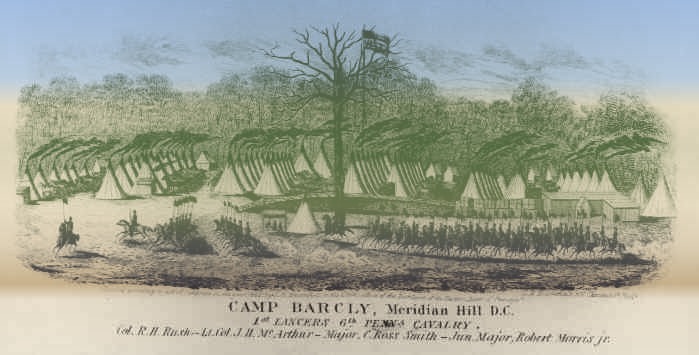
Among the mounted regiments that the Union threw into the field between 1861 and 1865, few looked the part quite like the 6th Pennsylvania Cavalry. Where the rest of the army carried carbines and sabres, these Philadelphians rode out beneath a forest of steel-tipped lances, each topped with a fluttering scarlet pennon. The sight gave them their enduring name, Rush’s Lancers, and it made them, for a season, the most talked-about horsemen in the Army of the Potomac.
The story is worth telling on its own terms. But for readers of this site there is a second thread running through it: a Derry emigrant named John Laird, who rose to Sergeant Major, survived twenty-seven engagements, and wrote home to his mother at the war’s end from the headquarters of the very cavalry division in which the Lancers served. His letter, and the emigration letter that preceded it, are transcribed in full in the Elagh Letters.
The cream of Philadelphia
The regiment was raised in the late summer and autumn of 1861, in the first rush of patriotic feeling that swept the city after the war began. Its recruits ran the usual gamut of a big city, upholsterers, clerks, tradesmen, farm boys from the surrounding counties — but its officers were drawn overwhelmingly from Philadelphia’s oldest and wealthiest families. Many had served in the First City Troop, a socially exclusive militia company whose lineage stretched back to the Revolution, when an earlier generation had acted as George Washington’s mounted bodyguard. Membership was by election only, and coveted accordingly.
Command went to Colonel Richard H. Rush, a professional soldier of impeccable pedigree. He was a grandson of Benjamin Rush, the physician who had signed both the Declaration of Independence and the Constitution, and a West Point graduate of the famous class of 1846, the class that also produced George McClellan, Stonewall Jackson, A. P. Hill and George Pickett. A Mexican War veteran with a solid reputation as an organiser, Rush had actually wanted an artillery command; the governor gave him a regiment of horse instead. He recruited most of its roughly seven hundred and fifty men himself and knew, it was said, every trooper by name.
The lance
The lances were not Rush’s idea. They came from McClellan, the army’s first commander and another Philadelphian of Rush’s West Point year, who had studied European cavalry and admired the shock value of Napoleonic-era lancers. In November 1861 he asked Rush whether he would care to arm his new regiment in that fashion. With few other weapons available, Rush agreed, enthusiastically, at least in his reply.
Each man was issued a nine-foot ash shaft tipped with an eleven-inch blade, modelled on an Austrian pattern and weighing around eight pounds, the whole crowned with that bright scarlet swallow-tailed flag. On parade it was magnificent. In the wooded, close country of Virginia it was close to useless, unwieldy in a fight, impossible to manoeuvre among trees, and a gift to Confederate marksmen, who found the pennons made excellent aiming points on picket duty. The rest of the army was merciless. The little flags, one relative of Rush reported, were being mocked as “hospital flags”; elsewhere the weapons were dismissed as “turkey drivers”. The men carried them anyway, and wore the name with pride, for the better part of eighteen months.
By May 1863 the experiment was quietly ended. The lances were handed in and Sharps carbines issued in their place, and it was as carbine-armed cavalry, not lancers, that the regiment fought its most famous action a few weeks later.
Brandy Station
On 9 June 1863, in the rolling farmland north of Culpeper, Virginia, the Union and Confederate cavalry collided in what remains the largest mounted battle ever fought on American soil. The 6th Pennsylvania had by then been folded into the Reserve Brigade of Brigadier General John Buford’s First Cavalry Division, a hard-bitten command otherwise made up of the Regular Army regiments, the 1st, 2nd, 5th and 6th United States Cavalry.
Buford’s men splashed across the Rappahannock at Beverly’s Ford in the pre-dawn mist and ran headlong into Confederate pickets. With the enemy’s horse artillery unlimbering on a ridge near St. James Church, Buford ordered the Pennsylvanians to charge the guns. They swept forward across some eight hundred yards of open ground, under grape, canister and rifle fire, cleared a run of deep ditches at the gallop, and reached the muzzles of the guns before the weight of Confederate reinforcements forced them back. Major Robert Morris Jr., the regiment’s commander, went down when his horse fell at a ditch and was captured. Major Henry C. Whelan took over in the saddle and later described the moment in a letter to a cousin:
We dashed at them, squadron front with drawn sabres, and as we flew along, our men yelling like demons, grape and canister were poured into our left flank and a storm of rifle bullets on our front.Maj. Henry C. Whelan, 11 June 1863
A second charge followed later in the day, against a stone wall held in force, with the 6th U.S. Cavalry riding in close support. Whelan had a horse shot from under him and called it the hottest place he was ever in, the air, he wrote, was almost solid with lead. When the fighting subsided the 6th Pennsylvania had taken the heaviest losses of any Union regiment on the field.
“My Seventh Regulars”
That day settled the regiment’s reputation. Buford, not a man given to easy praise, reported simply that his Pennsylvanians had done splendidly, and thereafter took to calling them his “Seventh Regulars”, the informal seventh member of his brigade of five Regular Army regiments. It was the highest compliment a volunteer unit could be paid. Some Confederates who faced them had already assumed as much, remembering them afterwards as Pennsylvania regulars rather than volunteers.
The Lancers went on to serve through the rest of the war, the Gettysburg campaign, the Overland battles, Sheridan’s raids and the Shenandoah Valley, down to the surrender at Appomattox in April 1865, before being consolidated with other Pennsylvania regiments and mustered out that August. Of the men who had ridden out from Philadelphia, roughly eighty were killed or mortally wounded in action, and nearly ninety more lost to disease.
A Derry man in blue
Which brings us to the Bogstown connection. Among the Elagh Letters is one written on 18 May 1865, a fortnight after the fighting had stopped, on the printed letterhead of the Headquarters First Cavalry Division, Army of the Potomac. Its author signs himself:
Sergeant John Laird, Sergeant Major of the 6th US Cavalry.
He is writing to his mother, sisters and brother back in Ireland, and the letter has the plain, grateful tone of a man who did not expect to see the end of it:
I have been in 27 hard fought engagements but thank God I am still alive as yet, I have never even been wounded but I have had some narrow escapes for my life. I used to often think when I would see my friends and comrades fall all around me that my time would soon come but thank God it never did.Sgt. Maj. John Laird, 18 May 1865
The details he gives line up precisely with the campaigns described above. He was taken prisoner in June 1863, the month of Brandy Station and the cavalry fighting around Stevensburg, and held for four months before being exchanged and rejoining his regiment, just in time for the Battle of Bristoe Station that October, where, he wrote, they lost nearly all their line officers. He describes nights spent lying out in drifting snow with only a blanket, thrown over his horse rather than himself, and the grim humour of veterans who could now laugh over the battles they had survived. By the war’s end he had risen to Sergeant Major, responsible for the regiment’s books, rolls and returns, the man who recorded, in his own morning reports, the wounded and the killed.
The regiment question. John Laird names the 6th U.S. Cavalry, one of the Regular Army regiments, and not, strictly, the 6th Pennsylvania. It is a distinction worth keeping straight, because the two are easily confused. But it makes the connection to Rush’s Lancers closer rather than weaker: the 6th U.S. and the 6th Pennsylvania rode in the same Reserve Brigade, under the same Buford, and fought shoulder to shoulder, the Regulars supporting the Lancers’ charges at Brandy Station and sharing every field thereafter. There is a quiet irony in it, too. The Lancers earned their proud nickname, “the Seventh Regulars”, precisely by winning the respect of the five Regular regiments they served alongside. John Laird was Sergeant Major of one of those very regiments. The Derry man was, in other words, one of the Regulars whose company gave Rush’s Lancers their name.
The letters home
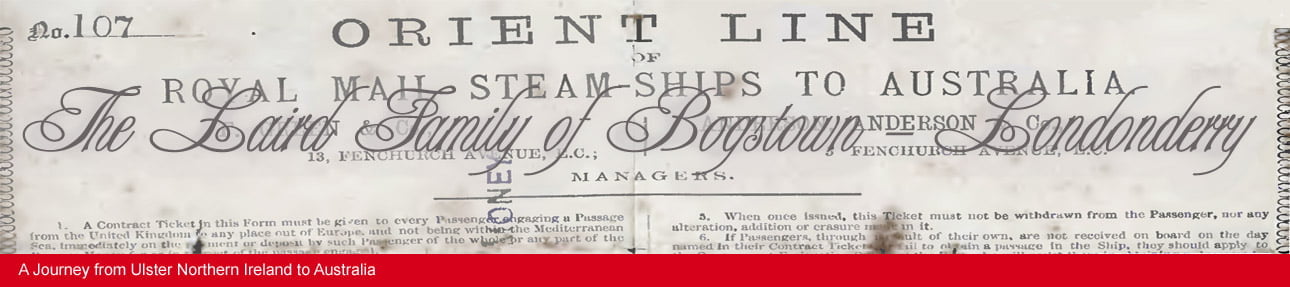
The 1865 letter is the second the family kept. The first, twelve years earlier, records the other end of the same journey. Written from Philadelphia on 30 June 1853, it describes the arrival of a party of Lairds after a passage of five weeks and three days out of Moville, met on the wharf by an uncle before the ship had properly docked. It is full of the small currency of emigrant correspondence, who was seasick and who was not, who had found a situation and who was still looking, love sent to a long roll of neighbours by name: Campbells, Horners, Wilsons, a Margaret Hunter newly settled in a place. These are the families of Elagh and Shantallow, and their names recur across the Bogstown records.
Between the two letters lies the whole arc of a life remade, a young man off a Derry emigrant ship in the 1850s, and a decorated cavalry sergeant-major a dozen years later, writing from Virginia as the guns fell silent. He closes the 1865 letter with news that had reached even the camps of the victorious army:
I suppose you have heard of the murder of our beloved President. His death is greatly lamented in this county… I hope it all leads to good for this land in the end.Sgt. Maj. John Laird, on the death of Lincoln
Lincoln had been shot on 14 April 1865, five days after Appomattox. That a farmer’s son from a townland outside Derry should be mourning the American President from a cavalry headquarters in Virginia is the kind of connection these family papers exist to preserve, the ordinary thread that ties a small parish in the north-west of Ireland to one of the defining events of the nineteenth century.
Sources: the Elagh Letters, transcribed in the Bogstown collection. Regimental history of the 6th Pennsylvania Cavalry and the composition of Buford’s Reserve Brigade drawn from published Civil War accounts of the Battle of Brandy Station, 9 June 1863. Quotations from John Laird are taken from his own letters home; the Whelan quotation is from his letter of 11 June 1863.
Members Comments